
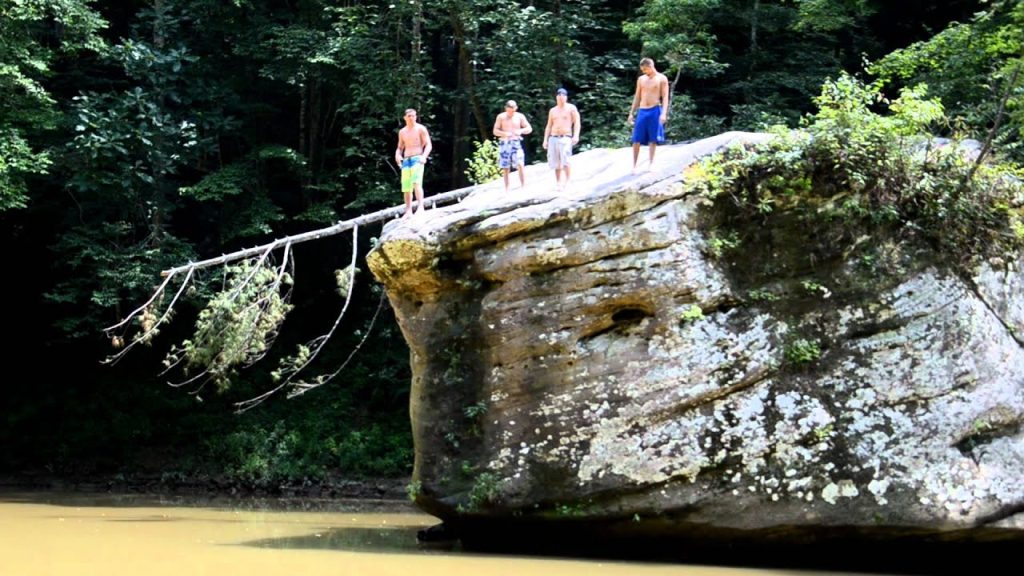
Key takeaways
- Yes, swimming is allowed. The New River Gorge National Park and Preserve does not ban it, but there are no lifeguards and no official designated swim beaches anywhere in the park.
- You swim at your own risk, and the risk is real. Undercut rocks, hydraulics below ledges, and current that looks slower than it is cause most of the trouble.
- Calm eddies, sandbars, and side channels at spots like Stone Cliff, Grandview Sandbar, and the flats near Sandstone Falls are where people actually get in. Nobody should be swimming in or below a rapid.
- Check the river gauge before you drive out. Flow changes fast, and an upstream release or a hard mountain rain turns a friendly swimming hole into moving brown water.
- Tributary swimming holes and Summersville Lake are the safer, easier answer if you just want to cool off in July.
On this page
- Is swimming allowed in the New River Gorge?
- Where can you swim in the New River Gorge?
- What makes the New River dangerous for swimmers?
- How do you check water levels before you go?
- Is the water warm enough to swim in July?
- What are the easier places to swim nearby?
- What should you bring for a day in the water?
- Frequently asked questions
Yes, you can swim in the New River Gorge. The National Park Service does not prohibit it, but it also does not run a single lifeguarded beach in the park, and there is no posted swimming area with ropes and a sandy bottom waiting for you.
What that means in practice: swimming here is legal and normal, and it is entirely on you to pick a good spot and read the water. Updated July 17, 2026, which is peak season for exactly this question.
Is swimming allowed in the New River Gorge?
Swimming is allowed throughout the New River Gorge National Park and Preserve, with no permit and no fee. The park does not designate swim beaches, does not staff lifeguards, and posts warnings at popular access points instead.
People sometimes read those warning signs as a ban. They are not. They are the park telling you plainly that if something goes wrong, the nearest help is a long way up a gorge road.
The same goes for most of the tributary creeks and the state park land around Bluestone and Sandstone. Rules can shift at specific access points, so read the sign at the trailhead or lot where you park. For anything official, including closures and current conditions, go straight to the park’s own website rather than trusting a travel blog from three summers ago.
Where can you swim in the New River Gorge?
The realistic spots are slow eddies, sandbars, and side channels well away from rapids. The lower gorge below Thurmond and the whitewater stretch toward Fayette Station are not swimming water, no matter how good they look from the overlook.
Stone Cliff, near Thurmond, has a beach area and river access where people wade and float in the slack water. Grandview Sandbar, reached by a road down from the Grandview area, gives you a boat launch and a gravel bar with quieter water off to the side. Both are popular with locals, which is usually a decent sign.
Around Sandstone Falls, the flats and side channels above and well below the falls draw families all summer. Do not swim at the base of the falls. Water pouring over a wide ledge recirculates at the bottom, and that recirculation is what pulls people under and holds them there.
Glade Creek and other tributaries hold pools that are shallower, clearer, and far easier to judge than the main river. If you have kids along, a creek pool beats the New River almost every time.
What makes the New River dangerous for swimmers?
Current, undercut rocks, and hydraulics, in roughly that order. The New is an old, big-volume river cutting through sandstone, and the surface tells you very little about what the water is doing three feet down.
Undercut and sieve rocks are the quiet killer. Water disappears under a boulder, and a swimmer gets pinned where nobody can reach them. From shore, that spot looks like calm green water next to a nice flat rock.
Foot entrapment is the other one people underestimate. If you stand up in moving water above your knees and your foot slips into a crack, the current folds you forward and holds you down. The rule from every raft guide in Fayette County is to float on your back, feet downstream, and swim to shore at an angle rather than trying to stand.
And the current is stronger than it looks. A river this wide moves slowly to the eye and quickly to the body. If you would not confidently swim 50 yards across a pool in street clothes, do not push out past the eddy line.
How do you check water levels before you go?
Check the river gauge the morning you go, not the week before. The New’s flow responds to rain across a huge watershed in Virginia and southern West Virginia, plus releases from Bluestone Dam above Hinton, so a sunny day in Fayetteville does not mean a low river.
The USGS gauges and the park’s water conditions page are the two things worth bookmarking. Rafting outfitters in Fayetteville and Oak Hill also post daily levels, and they have no reason to sugarcoat it.
The easier read is color. Green or clear water at a normal level is what you want. Brown, pushy water with debris riding the surface means the river came up, and it means the runoff carried whatever was on the ground into it. Give it a day or two after a heavy mountain rain.
Is the water warm enough to swim in July?
In July, yes. Mid to late summer is when the New is genuinely pleasant, warm enough that you are not gasping when you go under, and it stays that way into September most years.
Spring is a different river. Snowmelt and rain keep it cold and high through April and much of May, which is why guides put you in a wetsuit that time of year. The Gauley nearby runs colder in the fall because that water comes out of the bottom of Summersville Lake.
The bigger July problem is not cold water. It is the sun bouncing off the surface and the sandstone all afternoon. A long-sleeve shirt does more for you than repeated sunscreen touch-ups, which is why a hooded sun shirt with a real UPF rating is standard kit for people who spend whole days on the water here.
What are the easier places to swim nearby?
Summersville Lake is the low-stress answer. It is about an hour north of Fayetteville, has clear green water, an actual swim beach at Battle Run, and none of the current problems the river brings.
Bluestone Lake near Hinton is the other reservoir option, at the upstream end of the New. Water is murkier, boat traffic is heavier, and it is nowhere near as scenic as Summersville, but it is close and it works.
Beyond that, the creek pools are the sleeper choice. Glade Creek, Dunloup Creek, and half a dozen unnamed pockets off gorge roads are cold, shallow, and shaded. They are also where you learn the gorge is worth visiting outside of summer, since the same drives make good leaf-looking routes in October.
What should you bring for a day in the water?
A life jacket, water shoes, and more drinking water than you think. Those three cover most of what goes wrong on a river day here.
Life jackets are not just for kids and not just for rafts. The park recommends them for anyone in the water, and a properly fitted one is what keeps a bad swim from becoming a rescue. West Virginia has requirements for children on boats, so check the current rules with the DNR if you are putting a boat in.
Water shoes matter more than people expect. River rock here is slick sandstone with a coat of algae, and flip-flops come off in current. Closed-toe shoes with a strap heel are the move.
Pack a trash bag for wet suits and towels. Gorge access roads are gravel and dust, and river water plus grit ground into upholstery is a long-term problem. If your seats already took the hit, that is what a cleaner that is safe on leather is for. If you are camping after, a strand of solar lights over the site saves you from hunting for a headlamp at 10 p.m. Anything else you are shopping for a river weekend, our deals hub is the place to check.
Frequently asked questions
Is it illegal to swim in the New River Gorge?
No. Swimming is allowed throughout New River Gorge National Park and Preserve without a permit. The park simply does not designate official swim beaches or provide lifeguards, so every swim is at your own risk.
Where is the best place to swim in the New River Gorge?
Stone Cliff near Thurmond and Grandview Sandbar are the two access points people use most, both offering slack water off to the side of the main current. The flats and side channels near Sandstone Falls also draw families, though you should stay well away from the base of the falls itself.
How cold is the New River in the summer?
By July and August the New is comfortable for swimming without a wetsuit, and it stays that way into early fall. Spring is the cold season, when snowmelt and rain keep it high and chilly enough that outfitters put rafters in wetsuits.
Can you swim at Sandstone Falls?
People swim and wade in the calm side channels and flats around Sandstone Falls, but not at the base of the falls. Water pouring over a wide ledge creates a recirculating hydraulic that can hold a swimmer under, and that spot has a history of drownings.
Should you swim in the New River after it rains?
Wait. Heavy rain in the watershed raises the level, speeds the current, and washes runoff into the river, which turns it brown and pushy. Give it a day or two and check a USGS gauge before you go.
The short version: the New River will let you swim in it, and on a hot July afternoon it is one of the better places in the state to be. Pick an eddy, keep your feet up if you get swept, and treat the pretty flat rocks with suspicion.
If the river looks wrong when you get there, it is wrong. Drive to Summersville or find a creek pool instead, and come back when the gauge settles.
