
Key takeaways
- Copperheads are common in West Virginia. They turn up in nearly every county, and they are one of only two venomous snakes in the state along with the timber rattlesnake.
- They are most numerous below about 2,500 feet, so the southern coalfields, the Ohio and Kanawha valleys, and the Eastern Panhandle see more of them than the high country around Canaan and Snowshoe.
- Look for dark hourglass crossbands that are wide on the sides and pinch narrow across the spine, plus a plain copper or tan head with no bands.
- Copperhead bites are painful and require a hospital visit, but they are very rarely fatal. Most bites happen when somebody grabs, steps on, or tries to kill the snake.
- They are night hunters in hot weather, which is why July and August encounters usually happen at dusk on a porch step, a woodpile, or a warm trail.
On this page
- How common are copperheads in West Virginia?
- Which parts of the state have the most copperheads?
- How do you identify a copperhead?
- What snakes get mistaken for copperheads?
- When are copperheads most active?
- How dangerous is a copperhead bite?
- What should you do if you get bitten?
- What should you wear in copperhead country?
- How do you keep copperheads out of the yard?
- Is it illegal to kill copperheads in WV?
- Frequently asked questions
Copperheads are common in West Virginia. They are found in nearly every county, they are the state’s most frequently encountered venomous snake, and if you spend summers outdoors here you will eventually see one.
Common does not mean dangerous in the way people picture it. Copperheads are shy, mostly nocturnal in hot weather, and they would rather sit still and let you walk past than bite anything they cannot eat. Updated July 2026, right in the middle of the season when people actually run into them.
How common are copperheads in West Virginia?
Common enough that most rural West Virginians have a copperhead story, and rare enough that you can hike all summer without seeing one. West Virginia has around twenty native snake species and only two of them are venomous: the northern copperhead and the timber rattlesnake. Of those two, the copperhead is by far the one you are more likely to meet.
Part of that is habitat. Copperheads tolerate people better than rattlesnakes do, so they live in the edges we create: brush piles, old foundations, tumbled stone walls, sawmill slab piles, the ivy along the garage.
The other part is behavior. A copperhead’s whole survival plan is holding perfectly still and trusting its camouflage, which works. Plenty of people walk within a foot of one and never know it.
Which parts of the state have the most copperheads?
The lower, warmer parts. Copperhead density drops off sharply as you climb, so the southern counties, the Ohio River corridor, the Kanawha and Greenbrier valleys, and the Eastern Panhandle around Berkeley and Jefferson counties have the most.
Up in the Allegheny highlands, in places like Tucker, Randolph, and Pocahontas counties above roughly 2,500 feet, they thin out fast. Cold ground and short summers do not suit them. That is worth knowing if you camp at elevation or go chasing the high-country color routes in October, because your odds of a snake up there are low to begin with.
Within any given county they concentrate on south-facing rocky hillsides, powerline cuts, the rubble around old mine portals, and the transition strip where woods meet a field. Not deep forest, not open pasture. The seam between them.
How do you identify a copperhead?
Look at the shape of the bands, not the color. A copperhead’s dark crossbands are wide along the sides and pinch to a narrow waist over the spine, so from above they look like hourglasses or Hershey’s Kisses set point to point. The background is pinkish tan to copper, and the head is a plain unmarked copper or rusty brown.
Other markers: a heavy body for its length, usually two to three feet, with a stout look rather than a whippy one. The pupils are vertical slits, and there is a heat-sensing pit between eye and nostril. Do not get close enough to check either of those.
Young copperheads look like miniature adults with one extra tell, a bright sulfur-yellow tail tip they wiggle to lure frogs. A small snake with a yellow tail tip in West Virginia is a copperhead until proven otherwise.
What snakes get mistaken for copperheads?
Northern water snakes get killed for being copperheads more than any other snake in the state. They are blotchy, thick-bodied, bad-tempered, and they live in exactly the creeks and lake edges where people expect trouble. Their bands are wide across the back and narrow on the sides, the reverse of a copperhead’s hourglass.
Eastern milk snakes are the second big mix-up. They have reddish-brown blotches with black borders, but the blotches are separate saddles rather than bands that reach down the flanks, and the belly is a checkerboard.
Juvenile black rat snakes fool people too, since young ones are gray with dark splotches and look nothing like the glossy black adult. Eastern hognose snakes round out the list, and they are the ones that flatten their necks, hiss, and then flop over playing dead. None of those four are venomous.
When are copperheads most active?
In July and August they are mostly nocturnal, out from about dusk into the night when the ground gives back its heat. In spring and fall they flip to daytime activity and you are more likely to find one sunning on a rock ledge or a warm road in the middle of the afternoon.
Late summer into early fall is when encounters peak in West Virginia. The year’s young are dispersing, adults are moving toward denning rock, and people are still outside doing yard work and camping.
Practical version: if you are walking a farm road or a campground loop after supper in August, carry a light and point it where your feet are going. A headlamp with a low white setting is easier than a phone flashlight for that, and a rechargeable model with a red mode keeps you from blinding everybody at the fire ring.
How dangerous is a copperhead bite?
A copperhead bite is a genuine medical emergency but it is very rarely fatal. Their venom is the least potent of North America’s pit vipers, and a large share of bites are dry or deliver very little venom because the snake is defending itself rather than feeding.
What you get instead is serious local damage: immediate burning pain, fast swelling, bruising, and sometimes tissue injury that takes weeks to heal. Fingers and ankles do worst because there is nowhere for the swelling to go. Children, older adults, and anyone with a bad reaction need care fast regardless.
The statistic that matters most is behavioral. A large share of venomous snakebites in the US involve someone deliberately handling or trying to kill the snake, often with alcohol involved. Leaving it alone is close to a complete safety plan.
What should you do if you get bitten?
Get to an emergency room. Call 911 or the Poison Help line at 1-800-222-1222 on the way, and let the hospital know a pit viper bite is coming in so they can locate antivenom.
Before you go: take off rings, watches, and boots on the bitten limb before swelling starts, keep the limb roughly at heart level, and stay as calm and still as you can. Mark the edge of the swelling with a pen and note the time so the ER can see how fast it is spreading. A photo of the snake from a safe distance helps, but never go back for one.
Do not use a tourniquet, do not cut the wound, do not apply ice, and do not use a suction extractor. Every one of those makes tissue damage worse and none of them removes venom.
What should you wear in copperhead country?
Boots that cover the ankle and a light you can point at the ground handle most of the real risk. Copperhead fangs are short, so a leather upper over the ankle plus a thick sock is meaningful protection on the strike zone that gets hit most, the foot and lower leg. Full snake gaiters are overkill for casual hiking in WV, though they make sense if you are bushwhacking rocky south slopes or clearing brush by hand.
The bigger factor is where you put your hands and feet. Step on logs, not over them. Do not reach blind into rock crevices, under sheet metal, or into the gap behind a stacked woodpile.
KEFUWU Waterproof Mid-Top Hiking Boots

A mid-top leather hiker covers the ankle without feeling like a work boot, which is the sweet spot for summer trail walking in the mountains. Waterproofing matters more for creek crossings and wet laurel than for snakes, but you get both in one boot. Good pick if your current hiking shoes are low-cut trail runners.
- Mid-top ankle coverage
- Waterproof leather upper
- Non-slip lugged outsole
LARNMERN Side-Zip Hiking Boots
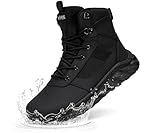
Side-zip tactical-style boots are easy to get on and off for evening chores around the property, which is when copperheads are moving in July. The wide toe box helps if regular hikers pinch. Worth a look alongside our guide to hiking boots for wide feet if sizing is your usual problem.
- Wide toe box
- Side zipper for quick on and off
- Non-slip outdoor sole
Pair either with a real sock. Cotton bunches, holds sweat, and gives you blisters by mile three, while merino wool hiking socks stay comfortable in Appalachian humidity. If you are shopping for someone with narrow options, women’s waterproof boots with a wide toe box cover the same ground.
How do you keep copperheads out of the yard?
Remove the cover and you remove the snakes. Copperheads move into a yard because it offers hiding places and rodents, so the fix is habitat, not chemicals.
Stack firewood off the ground on a rack and away from the house instead of leaving it heaped by the back door. Clear brush piles, old lumber, scrap metal, and rock rubble. Keep grass cut short along foundations and outbuildings, and pull ivy and thick groundcover back from doorways and steps.
Then cut the food supply. Sealed feed cans, no spilled birdseed, no pet food left on the porch overnight. Snake repellent granules and sonic stakes are a waste of money, and there is no evidence they do anything at all.
If you want to know what is actually moving through your property at night, a camera tells you more than guesswork. Plenty of folks running trail cameras with night vision for deer end up learning a lot about the rest of their acreage.
Is it illegal to kill copperheads in WV?
Snake rules in West Virginia are set by the DNR and they change, so check the current regulations summary at wvdnr.gov before you assume anything. Timber rattlesnakes in particular carry protections that copperheads do not, and season and limit language gets revised.
The practical answer is simpler. Killing a copperhead is how people get bitten, and a snake you leave alone in a woodpile is doing free rodent control. Move away, give it room, and it will be gone by morning.
If one is somewhere it genuinely cannot stay, like a garage or a chicken run, call your county DNR office or a licensed wildlife control operator rather than swinging a hoe at it.
Frequently asked questions
Are copperheads in every county in West Virginia?
They are recorded across nearly all of the state, but they are not evenly distributed. Numbers are highest at lower elevations in the south, west, and Eastern Panhandle, and much lower in the high Allegheny counties where the growing season is short and the ground stays cold.
Do copperheads chase people?
No. Copperheads freeze and rely on camouflage, and their usual escape is a slow retreat once they feel safe. A snake that appears to come toward you is almost always trying to reach cover that happens to be behind you.
How can you tell a copperhead from a water snake?
Check which way the bands narrow. A copperhead’s dark bands are wide on the flanks and pinch thin across the back, forming hourglasses, while a northern water snake’s bands are widest across the back. Water snakes also have patterned heads and round pupils, and they are the ones you see swimming in creeks and lakes.
Can a copperhead bite kill you?
It is possible but extremely uncommon. Copperhead venom is the weakest of the North American pit vipers and deaths are rare, though bites cause serious pain, swelling, and sometimes lasting tissue damage. Every bite should be treated as an emergency and evaluated at a hospital.
What time of year are copperheads most dangerous in WV?
Late summer through early fall sees the most encounters, when young snakes disperse and adults move toward denning sites. In hot months they are mainly active after dark, so evening yard work and night walks are when people run into them.
The short version is that copperheads are part of living in West Virginia the same way ticks and yellow jackets are. They are around, they are worth respecting, and they are not a reason to stay off the mountain in July. Watch your footing on rocky slopes, keep the woodpile tidy, carry a light after dark, and you have handled almost all of the actual risk.
If you are pulling gear together for summer hiking or evening chores around the place, our current deals hub is where the boots, lights, and outdoor clothing get rounded up.
