
Key takeaways
- October is the main garlic planting window for most of West Virginia. Aim for roughly two to four weeks after your first frost and four to six weeks before the ground freezes hard.
- High country (Tucker, Randolph, Pocahontas, Preston) plants late September through mid-October. The Eastern Panhandle, Ohio Valley, and the Kanawha lowlands can plant mid-October into early November.
- Soil temperature at 4 inches deep should be around 50 degrees and falling. That is the signal, not the calendar.
- Hardneck varieties suit our winters best and give you scapes in June.
- Plant cloves pointy end up, 2 to 3 inches deep, 6 inches apart, then mulch 4 to 6 inches deep with straw or shredded leaves.
Updated August 14, 2026.
What’s in this guide
- When should you plant garlic in West Virginia?
- How does elevation change the planting window?
- What soil temperature should you plant garlic at?
- What happens if you plant too early or too late?
- Hardneck or softneck for West Virginia?
- How deep and how far apart do you plant cloves?
- Do you need to mulch garlic over winter here?
- Can you plant garlic in spring in West Virginia?
- When do you harvest garlic planted in fall?
- Frequently asked questions
Plant garlic in West Virginia in October. That covers most of the state, most years, and it is the answer to reach for if you want one date range and nothing else: October 1 through October 31, with the middle of the month being the sweet spot for a lot of us.
The window shifts by a few weeks depending on where you live. Cloves go in the ground earlier in the high country and later down in the warm river valleys, and the rest of this guide sorts out which one you are.
When should you plant garlic in West Virginia?
The working rule is two to four weeks after your average first frost, and four to six weeks before the ground freezes solid. Garlic needs enough warm soil left in the season to push roots down, but not so much that it sends up a lot of top growth before winter.
For a Charleston or Huntington garden, that lands you in mid to late October. For Elkins or Davis, it lands in the last week of September or the first two weeks of October. Morgantown, Clarksburg, and Parkersburg sit right in the middle at early to mid October.
If you miss by a week either direction, nothing terrible happens. Garlic is forgiving. Missing by a month is where you start losing bulb size.
How does elevation change the planting window?
Elevation moves the window by about two to three weeks across the state. West Virginia is not one growing zone, and anybody who has driven from Martinsburg to Snowshoe in October already knows that.
| Area | Rough planting window |
|---|---|
| High country: Tucker, Randolph, Pocahontas, Preston, Greenbrier highlands | Late September to mid October |
| North central and Ohio Valley: Morgantown, Clarksburg, Parkersburg, Wheeling | Early to late October |
| Southern coalfields and Kanawha Valley | Mid October to early November |
| Eastern Panhandle: Martinsburg, Charles Town, Berkeley Springs | Mid October to early November |
Cold air also pools in the hollows, so a garden at the bottom of a draw frosts earlier than a garden on the hillside above it. Your own frost record beats any map. If you have been keeping notes on when the first frost hits your place, use those, and if you have not, this is a good year to start.
I wrote more about how our first frost timing varies across the state, and it pairs well with this if you are trying to pin down your own dates.
What soil temperature should you plant garlic at?
Plant when the soil at 4 inches deep reads around 50 degrees and is trending down. That is the actual trigger. The calendar is just a proxy for it.
A cheap probe thermometer stuck in the bed at mid-morning tells you more than any planting chart. Soil holds heat longer than air, so a couple of cold nights in late September does not mean the ground is ready.
Below about 40 degrees, root growth slows to a crawl. Above about 60, you get too much top growth too soon. The 45 to 55 range is where garlic roots hard and stays quiet up top.
What happens if you plant too early or too late?
Plant too early and the cloves send up green shoots in November that get burned back by hard freezes. The plant survives most of the time, but it spends energy it should have banked, and you usually end up with a smaller bulb in July.
Plant too late and the roots never get established before the ground locks up. Those cloves sit there all winter, sometimes heave up out of the soil during freeze-thaw cycles, and come up thin and late in spring.
If it is already Thanksgiving and you have cloves sitting on the counter, plant them anyway and mulch heavy. Late garlic beats no garlic. Just expect a smaller harvest.
Hardneck or softneck for West Virginia?
Hardneck. Our winters give garlic the sustained cold it needs, and hardneck types are bred for exactly that. Music, German Extra Hardy, Chesnok Red, and German White all do well through the mountains.
Hardnecks also throw scapes in June, which are one of the better free vegetables in a garden year. Cut them when they curl once and cook them like green beans.
Softnecks can work in the Eastern Panhandle and the warmer southern valleys, and they braid nicer and store longer. If you are in the high country, do not bother with them. Buy seed garlic from a grower rather than the grocery store, since store bulbs are often treated to resist sprouting and may carry disease you do not want in your beds.
How deep and how far apart do you plant cloves?
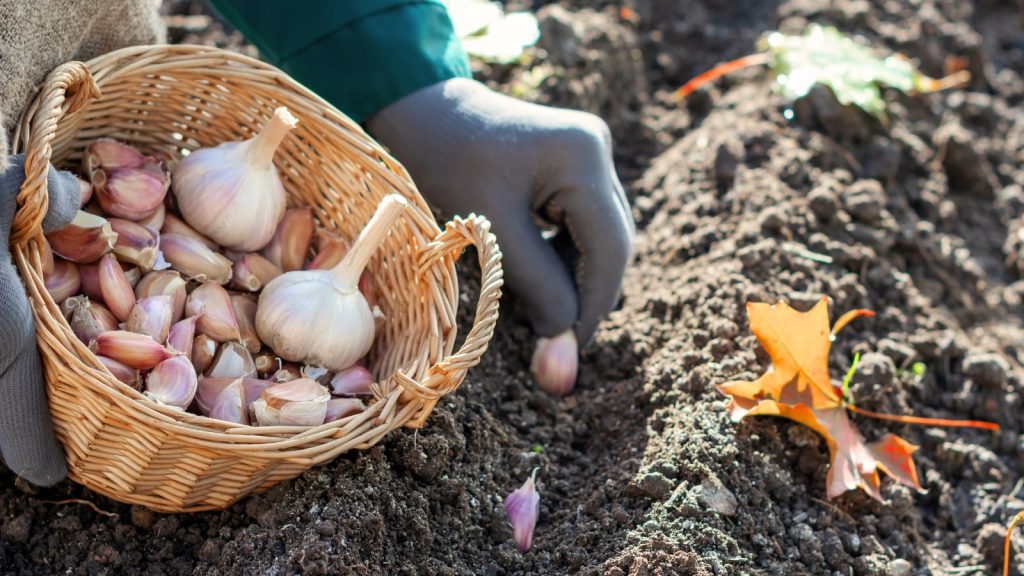
Break the bulb into cloves the day you plant, leave the papery wrapper on each clove, and set them pointy end up 2 to 3 inches deep. Space them 6 inches apart in rows about a foot apart.
Go 3 inches deep at higher elevations and in exposed beds. The extra inch buys real protection against frost heave.
Plant the biggest cloves and eat the small ones. Clove size is the single strongest predictor of bulb size next summer. Garlic wants loose, well-drained ground with compost worked in, which is a tall order in a lot of our soil, so a raised bed or a heavily amended row is worth the trouble. Our rocky clay fights back, and the tools that hold up in it are a whole subject of their own.
Do you need to mulch garlic over winter here?
Yes. Put down 4 to 6 inches of straw, shredded leaves, or old hay right after planting. Mulch is what keeps the soil temperature steady through our freeze-thaw swings, and those swings are the real threat, not the cold itself.
West Virginia winters bounce. A 55 degree Tuesday followed by an 18 degree Thursday pushes unmulched cloves right up out of the ground. Mulch stops that, holds moisture, and smothers the winter weeds that would otherwise get a head start on you.
Leave the mulch on in spring. The shoots come up through it fine, and it keeps weeds down while the bulbs size up. Pull it back only if your bed stays soggy.
Can you plant garlic in spring in West Virginia?
You can, but the bulbs will be smaller and many will not split into cloves at all. Garlic needs a stretch of cold, roughly six to eight weeks below 40 degrees, to trigger bulb formation.
If you have leftover cloves in March, get them in as soon as the ground can be worked. You will likely harvest single-clove rounds, which taste fine and can be replanted the following fall to grow into full bulbs.
Some people fake the cold by refrigerating cloves for several weeks before spring planting. It helps a little. Fall planting still wins by a wide margin.
When do you harvest garlic planted in fall?
Mid to late July in most of West Virginia, a week or two later in the high country. The signal is the lower leaves: when three or four of the bottom leaves have browned and the top four or five are still green, dig.
Loosen with a fork rather than pulling by the stem. Cure the bulbs in a shaded, airy spot for two to three weeks before you trim and store them.
That timing means garlic occupies the bed for about nine months, so plan the rest of the garden around it. By the time you are pulling bulbs, you are already thinking about fall, and by the time you plant the next round in October, deer season is on and the camp kitchen gets busy again. That is one reason October planting weekends fill up fast around here.
Speaking of which, October planting weekends have competition. If there is a home game and you are trying to get cloves in the ground the same Saturday, plant early and read up on where to park in Morgantown before you leave the house.
Once the beds are mulched and the garden is put to sleep, the season shifts indoors. That is about when the first fires start, and when people notice how much a stove changes the air in the house, which is worth thinking about before you deal with wood smoke inside in January. For garden gear and seasonal picks, our current deals page gets refreshed through the fall.
Frequently asked questions
Is October too late to plant garlic in West Virginia?
No, October is the ideal month for most of the state. Only the highest elevations benefit from planting in late September, and even there mid-October is workable. You can push into early November in the Eastern Panhandle and the warmer southern valleys.
Can I plant grocery store garlic?
You can, but it is a gamble. Store garlic is often a softneck variety grown in a warm climate and may be treated to prevent sprouting. Seed garlic from a regional grower is better adapted to our winters and less likely to bring disease into your beds.
Should I water garlic after planting it in fall?
Water once at planting if the soil is dry, then leave it alone. Fall and winter moisture in West Virginia is usually plenty, and soggy soil over winter causes more rot than drought causes damage. Pick watering back up in spring if May and June turn dry.
My garlic sprouted in November. Did I ruin it?
Almost certainly not. A few inches of green growth before winter is common when fall stays warm, and the plant will die back and regrow in spring. Add mulch over the shoots to buffer the freeze-thaw cycles and expect a slightly smaller bulb.
How much garlic should I plant?
Figure a bulb per person per week if you cook with it regularly, so 50 to 60 plants covers a household for a year. One pound of seed garlic gives you roughly 40 to 60 cloves depending on variety. Save your best bulbs each July to replant in October and you stop buying seed after the first year.
Garlic is close to the easiest thing you can grow in West Virginia, and the fall planting is the only part that requires paying attention. Get the cloves in during October, bury them deep enough, pile the mulch on, and you are done until June.
Mark your calendar now while you are thinking about it. Late August is when seed garlic sellers start taking orders, and the good hardneck varieties sell out well before anyone in the mountains is ready to dig.
