
The short answer
- Most split hardwood takes 6 to 12 months to dry to burnable moisture, stacked outside with air moving through it.
- Red and white oak are the outliers. Plan on 12 to 24 months, and don’t be surprised by the longer end.
- Ash, poplar, soft maple, and pine can be ready in a single summer if they’re split and stacked by March or April.
- Unsplit rounds barely dry at all. Bark holds moisture in, and a round can sit two years and still hiss on the fire.
- Dry means under 20 percent moisture on a fresh split face. A cheap moisture meter settles the argument in ten seconds.
What’s in this guide
- How long does firewood take to dry?
- Why does splitting cut the drying time so much?
- Which species dry fastest, and which take longest?
- How should you stack firewood so it dries?
- How long does firewood take to dry after rain?
- How do you know when firewood is dry?
- What happens if you burn wood that isn’t seasoned?
- When should you cut firewood in West Virginia?
- Frequently asked questions
Firewood takes 6 to 12 months to dry for most hardwoods, assuming it’s been split, stacked off the ground, and left where air can move through it. Oak is the famous exception and often needs 12 to 24 months. Softer woods like ash, poplar, and pine can be ready in three to six months of warm weather.
The wide range isn’t hedging. Species, piece size, stack location, and how much sun and wind the pile gets can double or halve the timeline. Here’s how each of those actually moves the needle, and how to tell when your wood is ready instead of guessing. Updated July 13, 2026.
How long does firewood take to dry?
Six to twelve months for most split hardwood. Freshly cut wood can be close to half water by weight, and every bit of that has to evaporate out through the ends and the exposed split faces. Wood dries fastest along the grain, which is why the cut ends do most of the work and why long, unsplit pieces dry so poorly.
A stack of split hickory or maple put up in March, out in the open with wind through it, is usually good to burn by that first cold snap in November. The same wood stacked in a shady hollow with weeds grown up around it might need another full year. Humidity in West Virginia hollows is real, and a pile that never sees a breeze just sits there staying wet.
If you want one planning rule: cut and split this year, burn it next year. Everything else is optimization.
Why does splitting cut the drying time so much?
Because bark is the tree’s raincoat, and it works just as well after the tree is down. A round with bark all the way around it can only lose moisture through the two cut ends, so it dries at a fraction of the rate of split pieces. I’ve seen rounds pulled out of a two-year-old pile that still ran water when they hit the maul.
Splitting opens the grain and multiplies the exposed surface. It also lets you control piece size, and size matters more than most people expect. A wrist-thick split dries in a few months; a big half-round the size of a dinner plate might need twice as long.
If you’re burning in a stove, split down to 4 to 6 inches across the face. Bigger chunks are fine for the occasional overnight load, but stack them separately and give them an extra season.
MEEPOCAN XL Manual Log Splitter

A manual splitting wedge with a self-locking blade is for people who split a few ricks a year and don’t want a hydraulic splitter sitting in the barn eleven months out of twelve. You set the round, drive the wedge, and keep your hands away from the strike zone. It won’t out-work a gas splitter, but it turns rounds into fast-drying splits without gas, oil, or a pull cord.
- Self-locking V-blade keeps hands out of the strike zone
- Welded steel build sized for larger rounds
- No gas, oil, or power cord required
Which species dry fastest, and which take longest?
Ash is the fastest hardwood, followed by poplar, soft maple, cherry, and pine. Oak is the slowest by a wide margin. That gap is mostly about wood density and cell structure, and no amount of stacking cleverness closes it.
Rough seasoning windows for split, well-stacked wood:
- Ash, poplar, pine, basswood: 3 to 6 months
- Cherry, soft maple, birch: 6 to 9 months
- Hickory, sugar maple, locust, beech: 9 to 12 months
- Red oak, white oak: 12 to 24 months
This is why a lot of us in West Virginia keep two piles going. Oak that came down in a spring storm gets stacked and forgotten until winter after next, while the ash and cherry from the same cleanup goes on the burn-this-year rack. If you’re dropping and bucking your own, a sharp chain does more for your afternoon than horsepower does, and the chain you put on the saw is worth more thought than most people give it.
How should you stack firewood so it dries?
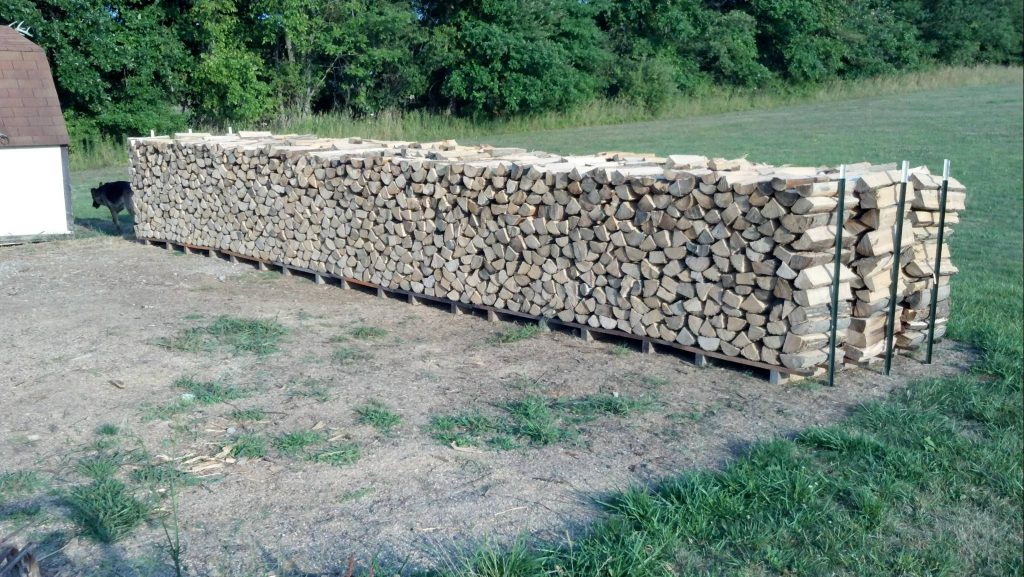
Off the ground, in single rows, in the sun and wind, with the top covered and the sides wide open. Those five things matter more than anything else you can do. Ground contact is the biggest killer, because the bottom row wicks moisture right out of the dirt and rots instead of drying.
Get the stack up on pallets, rails, or a rack. Run rows the direction of your prevailing wind and leave a hand’s width between rows if you’re stacking more than one deep. Wind pulls moisture out of a woodpile faster than sun does, and a pile tight against a building on three sides will disappoint you.
Cover the top only, with a tarp or a piece of roofing that overhangs a few inches. Wrapping the whole stack in a tarp traps evaporating water against the wood and gives you a mold farm instead of firewood.
Shelter Adjustable Log Rack Kit
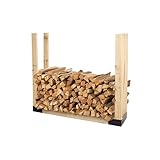
An adjustable steel rack kit is the cheapest way to solve the ground-contact problem without stacking on pallets that rot out from under you. You set the length to fit the space you have, which helps if you’re squeezing a rack alongside a shed or under a deep eave. If you want more options, we rounded up bracket kits and splitting tools separately.
- Adjustable length and height to fit tight spaces
- Powder-coated steel resists weather
- Keeps the bottom row off wet ground
How long does firewood take to dry after rain?
A few dry, breezy days. Rain only soaks the outer surface of seasoned wood, so a stack that got rained on isn’t ruined, it’s just damp on the outside. Two or three days of sun and wind and it’s back where it was.
The reason is that water moves into wood far more slowly than it moves out. Seasoned splits that spent a weekend in a downpour will read high on the surface and still be under 20 percent an inch in. Split one open and check the fresh face if you want proof.
What does cause trouble is wood that stays wet. A stack that’s rained on every week, never dries between soakings, and sits on wet ground will grow punky and lose heat value. That’s a covering and drainage problem, not a rain problem.
If you’re bringing wood inside, give it a day or two by the stove before it goes in. A wet-surfaced split will steam and smolder before it lights, and handling it with a decent pair of stove gloves beats fishing a hissing log back out with the poker.
How do you know when firewood is dry?
Split a piece open and put a moisture meter on the fresh face. Under 20 percent is burnable, 15 to 18 percent is where a stove really wants it. Testing the outside of a split tells you about the weather, not the wood.
Without a meter, use the old checks together instead of one at a time:
- Weight. Dry wood is noticeably lighter than green wood of the same species and size.
- Sound. Two dry splits knocked together give a sharp crack. Green wood gives a dull thud.
- Ends. Dry wood shows radial cracks running out from the center of the end grain.
- Bark. On most species it loosens and starts falling off as the wood dries.
- Fire. Dry wood catches fast and burns clean. Green wood hisses, bubbles at the ends, and blackens the glass.
End checking alone can fool you. Ends dry first, so a piece can crack beautifully on the ends and still be soaked in the middle, which is exactly why the fresh-split meter reading is the one that counts.
What happens if you burn wood that isn’t seasoned?
You lose heat and gain creosote. Every pound of water in the wood has to be boiled off before the wood burns, and that energy comes straight out of the heat you were trying to put in the house. Burn wood at 35 percent moisture and you’re paying a real tax in BTUs.
The bigger problem is what goes up the flue. Wet wood burns cool, cool smoke condenses on the pipe, and condensed smoke is creosote. That’s the sticky brown-black stuff that turns a chimney into a fire hazard, and a stove damped down on wet wood builds it faster than most people think.
Practical version: dry wood means less smoke, cleaner glass, hotter fires, fewer chimney sweeps. If your flue runs through cold space and you’re fighting condensation on top of it, pipe insulation and heat wrap help keep flue temps up, but nothing substitutes for dry fuel.
When should you cut firewood in West Virginia?
Late winter into early spring, so the wood gets a full warm season on the stack. February through April is the sweet spot. The leaves are off, the ground is firm enough to get a truck in, and the pile catches all of May through October to dry.
Standing dead trees are the shortcut people forget. A dead ash or locust that’s been standing with the bark sloughing off is already well along, and split in spring it can be burnable by fall. Just check it for rot and for anything living in it before you drop it.
Cutting in July, like a lot of us end up doing after a storm clears the driveway, isn’t wasted. It just means that wood is for next winter, not this one. Stack it now, forget it, and thank yourself in fourteen months. If you’re working with a smaller saw for limb wood and cleanup, we’ve covered the compact saws that hold up to real firewood work.
ZIMOMOTA Kindling Splitter

A kindling splitter is for the last mile of the drying question. Thin splits dry in weeks instead of months, so a handful of pieces run down to finger size in October will light a fire in November even if your main stack is borderline. You set the piece in the ring and tap it with a mallet, which keeps a hatchet out of the equation on a cold morning.
- Cast iron ring holds the piece while you strike
- Makes thin splits that dry in weeks
- Keeps a hatchet out of the morning routine
Frequently asked questions
Can firewood dry in one summer?
Yes, for ash, poplar, soft maple, cherry, and pine, if it’s split and stacked by early spring in a sunny, breezy spot. Dense hardwoods like hickory and sugar maple are borderline. Oak will not be ready, no matter how good your stack looks.
Does covering firewood with a tarp help or hurt?
Cover the top, never the sides. A top cover keeps rain and snow off the end grain, which is where water gets in fastest. Wrapping the whole stack traps the moisture that’s trying to evaporate out and slows drying to a crawl.
How long does firewood take to dry after splitting?
Splitting is the clock starter, so the usual 6 to 12 months for hardwood is measured from the day it’s split, not the day the tree came down. Rounds that sat a year in the woods have barely dried at all. Split them and start counting.
Can I dry firewood faster indoors or in a garage?
A garage or shed with open sides works well because it keeps rain off while air still moves. A closed garage without airflow is worse than an open outdoor stack. Bringing a few days’ worth inside near the stove is a fine finishing step, but don’t store a whole rick indoors unless you’re comfortable with the bugs that come with it.
What moisture percentage should firewood be before burning?
Under 20 percent, measured on a freshly split face. Fifteen to eighteen percent is where most stoves burn cleanest. A basic pin-style moisture meter is inexpensive and removes all the guessing.
The whole thing comes down to a boring habit: split it, get it off the ground, cover the top, and give it a year. Wood that dried right burns hot, keeps the glass clear, and doesn’t line your flue with tar. Wood that didn’t will remind you of it every night in January.
If you’re setting up a stack this summer or replacing the racks that rotted out, browse the current tool and outdoor deals and get it built before the weather turns. Stacking in July is unpleasant. Stacking in November, in the rain, is worse.
